The best boss feels the least
How your brain changes the moment you become the boss
I once read a scientific finding that has stayed with me ever since: people who end up in leadership positions immediately score higher on abstract abilities. And when they lose that leadership position, those abilities decline again [1].
This surprised me enormously. I had always assumed that intelligence was "fixed" — abstract abilities can be seen as a form of intelligence. But that intelligence appeared to be variable and context-dependent. It kept nagging at me.
In my mind, I began combining this with another observation: people who acquire leadership positions can suddenly be perceived as cold and distant by their former colleagues. And I have heard leaders themselves say that they had perhaps become colder and more distant after their promotion. One might say that their empathic intelligence appeared to diminish.
I thought it would be worthwhile to investigate this in the literature. Has it been described more often that leaders become more skilled at the abstract level? Are they also better leaders? Does the literature show that leaders decline in empathy? And might there be a connection between these things?
Power creates distance, and distance makes abstract
The Construal Level Theory by Trope and Liberman [2] [3] posits that our brain has one mechanism for processing everything that is "far away" — far in time, in space, in probability, and in social distance. The further something is removed from us, the more abstractly we think about it. We then focus on the broad outlines and filter out details.
Power is a form of social distance [4]. Those in power experience more distance from their subordinates than the other way round. This is also logical: the employee has only one boss, the leader has a hundred employees. And that unequal distance activates the mechanism just described: the leader's brain switches to more abstract thinking. As a result, leaders have less motivation and less capacity to accurately assess the mental state of others. That is not "ugly" — it is how the brain appears to work. This mechanism has been robustly confirmed in a meta-analysis of 106 articles with 267 experiments: psychological distance leads to abstraction, across cultures and settings [5]. It is a universal human mechanism, not an ugly individual character trait.
The brain lumps all types of distance together
All forms of distance appear to be interconnected in the brain [6]. When someone is socially distant from us — such as a powerful executive — we automatically perceive that person as "far away" in time and space as well, and even as more hypothetical. The brain lumps power, distance and unreality together.
The podium and the top floor
It also works physically. The metaphor "standing at the top" is not just language [7]. Literally standing high up — on a podium, a high floor — triggers abstract thinking. The brain links the physical experience of height to cognitive abstraction. The podium at the shareholders' meeting and the office on the top floor activate more abstract thinking.
This therefore explains why that warm colleague who gets promoted starts to feel colder. Not because they become a bad person. But because their brain — triggered by the social distance that power brings — switches to a more abstract register.
Why would this be useful?
Why would our brain be built this way? From an evolutionary perspective, mechanisms only survive if they are functional — otherwise evolutionary selection pressure would have eliminated them long ago.
An elegant hypothesis offers an answer here: the Opposing Domains Hypothesis [8]. Our brain has two fundamentally different ways of understanding the world, and they cannot run simultaneously. There is an analytical mode with which we comprehend objects, mechanisms and causal relationships. And there is an empathic mode with which we understand people, experiences and moral situations.
For leaders, this is a double-edged sword. Those who become responsible for strategy, resources and results automatically activate the analytical mode. People become "resources". Teams become "assets". Employees become means to an end. Not out of malice — but because the brain needs that abstraction to operate at the level required.
Is the abstract leader a better leader?
Yes, is actually the answer. The CEO is more effective when she communicates abstractly: vision, values, direction [9]. Direct managers are more effective when they communicate more concretely: specific feedback, concrete tasks. There must be a fit between position and degree of abstraction. When a senior boss becomes too concrete, it is called micromanagement. When a direct manager acts too visionary, nobody understands what the intention is.
People become means
But this effectiveness comes with a shadow side, because that abstract thinking causes leaders to see others less as individuals and increasingly as means to achieve a goal — which in the literature is called instrumental perception [10]. The leader pays less attention to the unique, concrete situation of an employee and more to their general usefulness.
Cold but fair
At the same time, such a "cold" abstract leader can often make better choices for the collective interest of the group [11]. In negotiations, abstract thinking led to better outcomes for the group as a whole. The shift is therefore not simply from "good" (empathic) to "bad" (cold), but from the individual to the system. The "cold" executive who no longer empathises with Jan in the department may be better able to weigh up what is good for two hundred employees as a whole. So this too is a situation in which an abstract leader is a better leader.
The blind spot of the visionary leader
And the nuance: abstraction is no panacea — abstract leaders also become more risk-seeking [12]: they can focus on the desirability of the outcome and less on the concrete probability that things will go wrong. That can be good for the company — daring to take big steps — but disastrous for the people in the organisation when it goes wrong.
"He has no idea what this means for us"
And so a fundamental communication problem can also arise during organisational changes. Leaders look at the abstract "why", employees panic about the far more concrete "how" [13]. The boss sees the broad outlines, the employee sees the problems. That mismatch is experienced on the shop floor as a lack of empathy: "He has no idea what this means for us."
In short: abstract thinking is functional for the strategic role, but the price is a diminished ability to see people as individuals. That price is paid by everyone around the leader.
Why you cannot do both at once
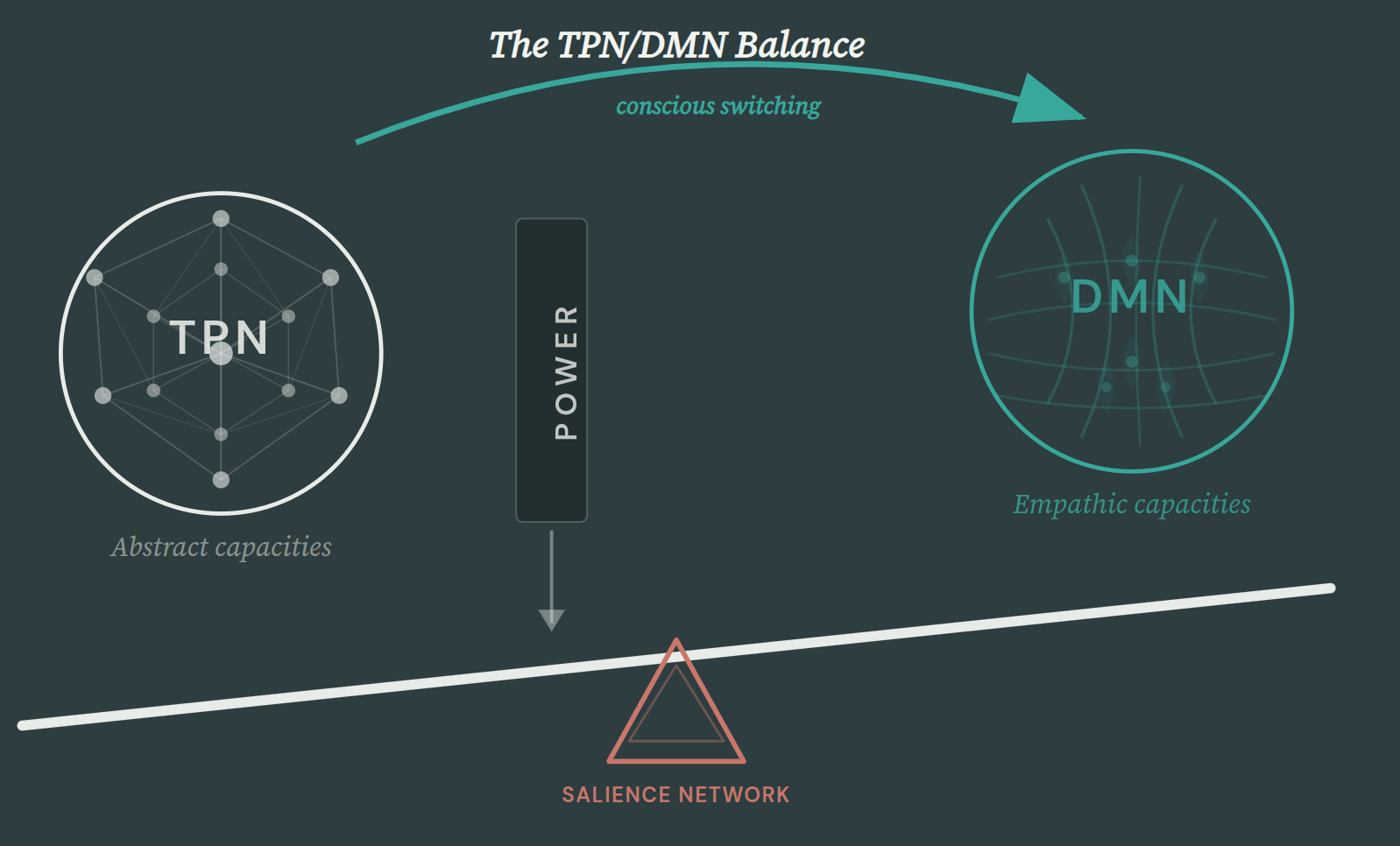
The Opposing Domains Hypothesis [8] from earlier, which articulates this "struggle" between abstraction and empathy, finds a beautiful translation in the neurosciences. Two large-scale networks are described in the brain that are antagonistic — they actively suppress each other [14]. The Task-Positive Network (TPN) becomes active during problem-solving, focus and decision-making. The Default Mode Network (DMN) becomes active during empathy, self-reflection and ethical thinking. The key finding: when the TPN switches on, the DMN switches off. From a neurological perspective, it is very difficult to be analytical and empathic at the same time. Leaders who are stuck in task mode therefore suppress their capacity for empathy.
The brain is not quite that simple either
Now, it is fair to note a caveat here. The brain is not as simple as we sometimes like to think — and metaphors do go awry. The DMN can also actively contribute to task performance by forming flexible connections with other networks [15]. And empathy is not one thing: cognitively understanding what someone feels operates on a different circuit from actually feeling along with them [16]. But the main thrust appears to be that these systems compete for neural "bandwidth".
Empathy does not fit in a full head
Recent research also examined what happens to prosocial behaviour when people are under high cognitive load (the chronic state of the average executive) — and yes, cognitive load suppresses the brain regions that are crucial for empathy [17]. The interests of others receive less of the total "bandwidth" in an already "full" brain. Empathy is not a static character trait, but dependent on the space available for it. But not for everyone: some remained prosocial under pressure.
The brain apparently makes a cost-benefit analysis [18]. Empathy costs bandwidth — bandwidth that can also be deployed for analytical thinking. The brain of the person in power chooses — often automatically and unconsciously — the most efficient route to the goal, and that is often abstraction. We already saw that this indeed produces better leaders.
The switch: there is a way out
Is it then the case that substantively "good" leaders are condemned to an existence devoid of empathy — and that those being led must be left out in the cold? Fortunately, it is not quite that extreme.
Even though the one partly excludes the other — switching appears to be perfectly possible. A third network is described in the brain — the Salience Network — that functions as a switch between the analytical and the empathic mode [19]. People who can switch flexibly with it are mentally healthier and cognitively more flexible. The problem does not appear to be that leaders are in analytical mode, but rather that they no longer switch back. And that switching ability appears to be trainable. Mindfulness (the buzzword of the last 15 years) appears to be useful here as well [20]. And the manner in which you coach matters: coaching for compliance versus coaching with compassion. The latter re-activates empathy [21].
The paradox of leadership
Being simultaneously empathic and analytically sharp is actually not feasible — our brain is simply not built for it. And that is good for leaders to know: choose your mode, choose your network, depending on the context in which you operate. Running the two modes simultaneously is neurologically very difficult for most people — but consciously alternating is not!
That, then, is a remarkable paradox of leadership. The skills that bring you to the top — analytical thinking, abstraction, focus on the system — suppress precisely the skills you need to bring people along. The best leaders are perhaps not those who choose between the strategist and the coach, but those who have learnt to switch deftly.
Literature
[1] Smith, P. K., Wigboldus, D. H. J., & Dijksterhuis, A. (2008). Abstract thinking increases one's sense of power. Journal of Experimental Social Psychology, 44(2), 378–385.
[2] Trope, Y., & Liberman, N. (2010). Construal-level theory of psychological distance. Psychological Review, 117(2), 440–463.
[3] Trope, Y., & Liberman, N. (2012). Construal level theory. In P. A. M. Van Lange, A. W. Kruglanski, & E. T. Higgins (Eds.), Handbook of theories of social psychology (Vol. 1, pp. 118–134). SAGE Publications Ltd.
[4] Magee, J. C., & Smith, P. K. (2013). The social distance theory of power. Personality and Social Psychology Review, 17(2), 158–186.
[5] Soderberg, C. K., Callahan, S. P., Kochersberger, A. O., Amit, E., & Ledgerwood, A. (2015). The effects of psychological distance on abstraction: Two meta-analyses. Psychological Bulletin, 141(3), 525–548.
[6] Fiedler, K., Jung, J., Wänke, M., & Alexopoulos, T. (2012). On the relations between distinct aspects of psychological distance: An ecological basis of construal-level theory. Journal of Experimental Social Psychology, 48(5), 1014–1021.
[7] Slepian, M. L., Masicampo, E. J., & Ambady, N. (2015). Cognition from on high and down low: Verticality and construal level. Journal of Personality and Social Psychology, 108(1), 1–17.
[8] Jack, A. I. (2014). A scientific case for conceptual dualism: The problem of consciousness and the opposing domains hypothesis. In J. Knobe & S. Nichols (Eds.), Oxford Studies in Experimental Philosophy (Vol. 1). Oxford University Press.
[9] Berson, Y., & Halevy, N. (2014). Hierarchy, leadership, and construal fit. Journal of Experimental Psychology: Applied, 20(3), 232–246.
[10] Wiesenfeld, B. M., Reyt, J.-N., Brockner, J., & Trope, Y. (2017). Construal Level Theory in Organizational Research. Annual Review of Organizational Psychology and Organizational Behavior, 4, 367–400.
[11] Stillman, P. E., Fujita, K., Sheldon, O., & Trope, Y. (2018). From "me" to "we": The role of construal level in promoting maximized joint outcomes. Organizational Behavior and Human Decision Processes, 147, 16–25.
[12] Raue, M., Streicher, B., Lermer, E., & Frey, D. (2015). How far does it feel? Construal level and decisions under risk. Journal of Applied Research in Memory and Cognition, 4(3), 256–264.
[13] Berson, Y., Oreg, S., & Wiesenfeld, B. (2021). A construal level analysis of organizational change processes. Research in Organizational Behavior, 41, 100148.
[14] Boyatzis, R. E., Rochford, K., & Jack, A. I. (2014). Antagonistic neural networks underlying differentiated leadership roles. Frontiers in Human Neuroscience, 8, 114.
[15] Elton, A., & Gao, W. (2015). Task-positive functional connectivity of the default mode network transcends task domain. Journal of Cognitive Neuroscience, 27(12), 2369–2381.
[16] Vemuri, K., & Surampudi, B. R. (2015). An exploratory investigation of functional network connectivity of empathy and default mode networks in a free-viewing task. Brain Connectivity, 5(6), 384–400.
[17] Liu, Z., Liu, J., & Cui, F. (2025). Exploring individual differences in the impact of cognitive constraints on prosocial decision-making via intrinsic brain connectivity. Brain Imaging and Behavior, 19, 1330–1341.
[18] Hu, J., Hu, Y., Li, Y., & Zhou, X. (2021). Computational and neurobiological substrates of cost-benefit integration in altruistic helping decision. The Journal of Neuroscience, 41(15), 3545–3561.
[19] Lydon-Staley, D. M., Kuehner, C., Zamoscik, V., Huffziger, S., Kirsch, P., & Bassett, D. S. (2019). Repetitive negative thinking in daily life and functional connectivity among default mode, fronto-parietal, and salience networks. Translational Psychiatry, 9(1), 234.
[20] Chou, T., Dougherty, D. D., Nierenberg, A. A., & Deckersbach, T. (2021). Restoration of default mode network and task positive network anti-correlation associated with mindfulness-based cognitive therapy for bipolar disorder. Journal of Affective Disorders.
[21] Boyatzis, R. E., & Jack, A. I. (2018). The neuroscience of coaching. Consulting Psychology Journal: Practice and Research, 70(1), 11–27.