The higher up, the angrier
Why equals clash more fiercely than unequals
Throughout my career I have occupied many different positions in the hierarchy. I have been the most junior clerk in the hospital, the least experienced consultant in the consultancy — and the managing partner.
What struck me was that more emotion was shown in the highest echelons than in the lower ones. Anger, above all. Up there it seemed perfectly normal and accepted to display so much anger. And that contrasted sharply with my earlier positions: "lower down" you simply did not do that, you did not show anger. It hardly even crossed my mind. I saw the same in doctors' partnerships and medical staff: large, forceful emotions flew across the table there, and that appeared to be considered entirely normal.
I found it astonishing. I had not expected it from "the top". I had assumed that there people acted predominantly rationally — and, by my definition at the time, large emotions such as anger had no place in that. And this is not an observation from some distant past. In my current work as a coach and teacher on leadership programmes for senior management, I see this pattern returning again and again. Board members who do not understand why their management team behaves so explosively. Partners who feel they are "always" the ones who have to straighten things out. Employees who cannot grasp why their director so often erupts. And directors who wonder why they themselves feel and display so much anger.
One possible explanation is that at the top there is often little hierarchy between partners, colleagues or board members. The familiar instrument of hierarchy ("we will do it this way, because I am the boss") is simply not available to resolve disagreement. People at the top therefore quite literally cannot do anything other than display large emotions — because no other means of working through differences of opinion is available.
The literature amply confirms this. An angry partner or board member is not an isolated incident. In fact, it builds on the insight that power alone alters your brain and weakens your empathy.
That immediately raised the question of who suffers from this and what can be done about it. Naturally, a subordinate can be deeply affected by an angry boss, which is why below I first address vertical anger — how it works between people in hierarchical relationships. I then turn to horizontal anger — anger between peers at the top.
Vertical anger
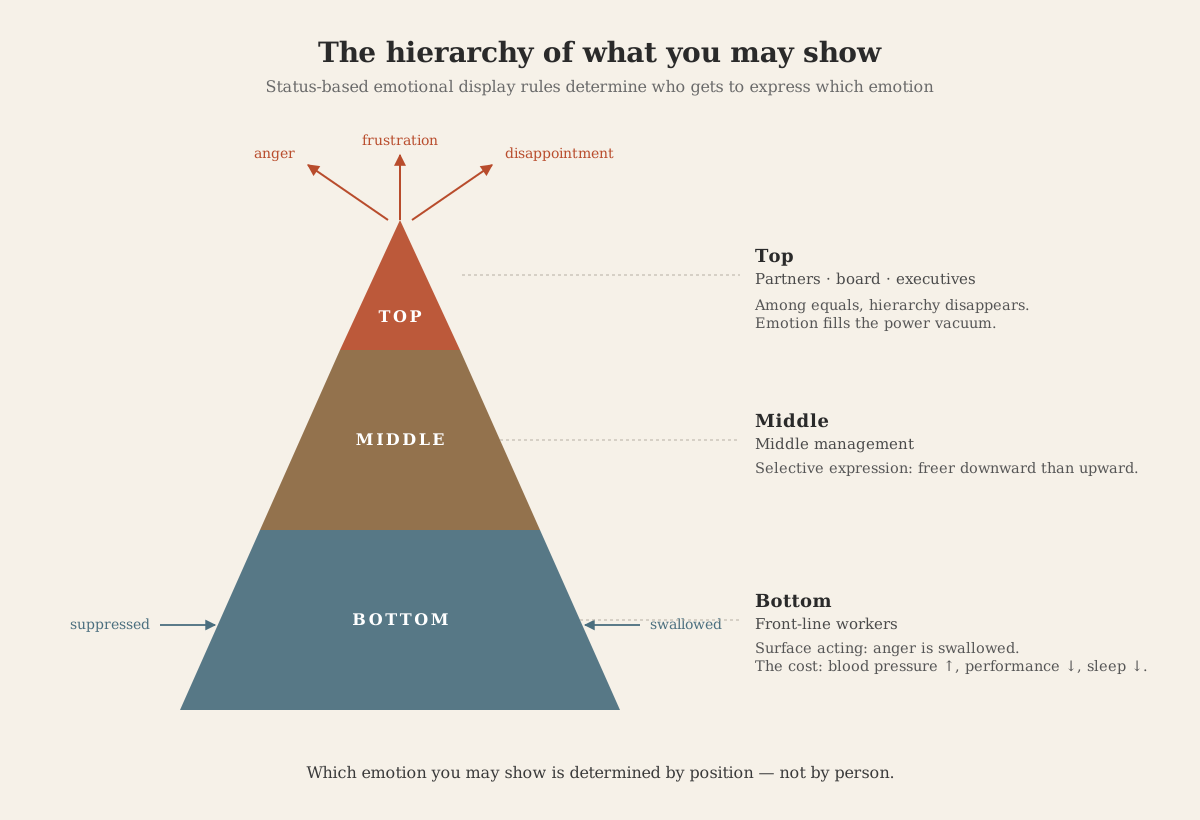
Lower in the organisation you hide your anger; higher up you display it. The literature confirms this and has, of course, given it an elegant name: status-based emotional display rules — implicit but clear rules that determine who is permitted to show which emotion [1].
Differences in anger higher and lower in the hierarchy
In conflicts, subordinates certainly experience anger and frustration too, but they do something very different with it. They hide and suppress their frustration almost systematically. Leaders, by contrast, express those same emotions much more openly [1]. Subordinates also genuinely consider it more desirable to suppress their "negative" emotions in front of someone of higher status [2]. It is not that people at the top are temperamentally more volatile or unstable; the implicit prohibition on expressing such emotions has been lifted, and that simply makes them more visible.
Intriguingly, the two groups can also become angry for different reasons. Leaders more often become angry about incompetence — when work has not been done well or efficiently [3]. Subordinates are more exercised by unfair treatment. You can easily imagine, then, how an angry managing partner and a frustrated junior in a conflict end up talking rather emphatically past one another.
Unequal distribution between men and women
It is important to note that the "privilege" of being able to become angry without penalty is not fairly distributed between men and women. Where anger in a male leader is still regularly accepted as passion or decisiveness, female leaders are punished socially far more severely. Their anger is more often attributed internally ("she is too emotional" or "she is losing control") rather than to the situation [4]. In practice, the angry boss is more often a man than a woman.
The effect of a leader's outburst on a subordinate is strongly shaped by how that subordinate responds. When the subordinate displays fear or sadness, the angry leader is seen as more powerful than when the recipient remains neutral or becomes angry in return [5]. You can view fear and sadness in response to anger as a form of submission, which reinforces the dominance already in place. A certain imperturbability in subordinates can therefore be destabilising for the senior who has just erupted — it diminishes the existing dominance, something which could make that senior angrier still.
And while we are on the subject of the angry boss: anger sometimes becomes chronic and turns into persistent intimidation — abusive supervision. One might assume that such an angry boss has a robust self-image — yet the opposite is true. When a subordinate turns out to be genuinely competent, that strikes certain leaders precisely where it hurts: their own self-image comes under pressure. That threatened self-image then translates into abusive behaviour [6]. Anger as a defence against a rising inner insecurity.
Horizontal anger
But why, then, does the expression of forceful emotion happen so frequently precisely between people of equal rank? Why do partners, who formally hold no power over one another, end up at each other's throats?
The communicative capacity of anger
This can be nicely explained from the Emotions as Social Information (EASI) theory. That theory holds that emotions should be seen as instruments for influencing others [7]. The more recent Theory of Affective Pragmatics goes a step further and argues that non-verbal emotional expressions possess a communicative capacity equivalent to that of spoken language! Emotions are therefore not wild upsurges from some evolutionary remnant in our limbic brain. They are utterances that convey intentions and requests [8]. The angry colleague, then, is not "overcome by emotion"; he is communicating, not through spoken language but through the instrument of emotion.
Among "equals", once differences in power have fallen away, every decision has to be "negotiated out". And what works exceptionally well in negotiations? Anger. Whoever displays anger at the negotiating table demonstrably extracts more concessions than someone who does not [9]. Showing anger turns out to be an effective strategy for forcing a decision when you are not the ultimate boss. Anger substitutes for hierarchy.
But anger also carries a price. Although in the short term you extract concessions and win the discussion, you inflict lasting damage. You lose relational satisfaction and "perceived warmth" [9], and people attribute to you lower competence and lower status [10]. They bow to your wrath, but privately consider you the poorer professional. Your image and authority suffer permanent harm.
The sorry paradox
Suppose the most senior boss has cooled down after an outburst and says "sorry". That often backfires! People with less power quickly interpret an apology from the boss as cynical or manipulative — in any case, not sincere [11]. If that same subordinate then refuses to accept the apology, that paradoxically evokes fear in the boss — which in turn compels that leader to further concessions [12]. Even without stripes on your shoulders, then, you have a powerful weapon at your disposal: the strategic withholding of forgiveness.
The hidden burden of the subordinate
Subordinates feel at least as many negative emotions as their leaders, but are not allowed to show them. Every time a subordinate laughs off frustration because that is simply what is expected, he is engaging in surface acting: putting on a face while inside he may be boiling.
Physical stress from not expressing anger
The toll this takes is considerable. Hiding anger measurably raises blood pressure [13] [14]. Feeling anger but not expressing it leads to measurably poorer performance [15]. And regular surface acting undermines one's ability to relax in the evening, impairing sleep [16].
This is important to name, because it shifts the moral centre of gravity of the story. While the partner at the top has the luxury of expressing his anger — with or without damage to his image — the subordinate carries the burden of not being permitted to express it at all.
How to handle all this anger
Vertical and horizontal anger lead to three concrete situations, each of which calls for its own approach.
A. As a leader, expressing your own anger 'wisely'
Let us begin with the person who most readily and most visibly displays anger: the leader. Precisely because it comes so easily, the responsibility to do it well is greatest.
The first instrument is selectivity. The effect of anger lies not in sustaining it, but in contrast. A leader who is normally amiable and only becomes angry at a specific moment extracts more concessions and retains a better relationship with the other party than a leader who is continually angry [17]. Whoever is angry all day loses authority; whoever deploys it selectively gains it.
The second instrument is the choice of emotion. Whoever shows disappointment instead of anger activates guilt in the other — which leads to greater pliability. Whoever is genuinely upset but consciously opts for disappointment reaps more influence [18].
The third instrument is moral anchoring. The literature describes moral anger as a distinct, morally motivated emotion, to be distinguished from everyday irritation [19]. When a leader becomes angry about unethical behaviour — fraud, boundary-violating conduct, the endangering of safety — fine things can happen. A shared climate of fairness arises, and the team's performance capacity and viability increase. Anger as an instrument of ego is harmful; anger as a guardian of integrity is powerful leadership [20].
Together, these three instruments constitute a mature way for a leader to handle his own anger: briefly shown, deliberately chosen, and morally anchored.
B. As a peer, handling an angry colleague at the top 'analytically and reflectively'
The second situation plays out between equals. There is no hierarchy to delimit the other's anger, and so the recipient's own disposition must do the work.
The trap is surface acting: laughing it off and nodding diplomatically while seething inside. That not only fails to work — it undermines your own body and sleep, as we saw above.
The alternative is cognitive reappraisal or conflict detachment. Rather than rigidly fixing your face into a mask (surface acting), you change how you intellectually view the situation. You mentally take a step back and ask yourself: "Why is he behaving this way? What lies beneath this? Which decision is he trying to force?" By regarding your colleague's anger — in line with EASI theory — analytically, as a clumsy means of communication rather than a personal attack, it affects you less. The literature shows that this very capacity to detach yourself temporarily from the conflict protects your cognitive performance, counteracts exhaustion, and yields better sleep [15] [16].
C. As a subordinate, handling an angry superior with equanimity
This is the most difficult of the three situations — and also the one for which the literature offers the least in the way of advice. For the subordinate has no equivalent bargaining position.
What we do know comes down to three things.
First: do not reactively fall back on fear or sadness. That actually reinforces the dominance of the angry boss [5] and feeds his anger rather than dampening it. A calm, imperturbable demeanour may be hard to adopt, but it is highly effective in dealing with an angry boss.
Second: use the sorry paradox. If the boss later offers his apologies, you are not obliged to accept them immediately. The strategic withholding of forgiveness evokes fear in the holder of power and compels him to far-reaching concessions [12]. It is one of the few instruments that genuinely grants power to someone who formally has none. But if you are dealing with a boss whose outbursts stem from deep insecurity or an extremely low self-image [6], strategically refusing an apology may also blow up the working relationship altogether. So use this lever deliberately, but sparingly.
Third: protect your body and sleep through cognitive reappraisal and emotional detachment. You may not be able to shout back, but you can prevent every incident from driving up your blood pressure. This provides real protection for your health in a structurally unequal position. So ask yourself: what is the real message of this anger?
Conclusion
Large emotions at the top are, in principle, not signs of dysfunctional leaders or a toxic culture. They are primarily the consequence of the absence of hierarchy, which requires other mechanisms to explain to one another what is intended, and to arrive at a shared solution.
But understanding that the mechanism is natural is not the same as saying that it is a given. A leader can absolutely learn to handle his own anger better. For himself, for the peers who have to absorb his anger, and for the subordinates who are not even allowed to answer back. Anyone who grasps how heavily an angry outburst lands on another person carries the added responsibility of deploying it consciously. And in organisations where leaders consider it normal not to temper vertical anger with the instruments described here, one may well ask whether the label "toxic" ought, after all, to be used.
Having insight into how all this works helps one to modulate and endure that storm of anger, in the absence and in the presence of hierarchy.
References
[1] Kalter, M., Bollen, K., Euwema, M., & Verbeke, A. (2021). A matter of feelings: Mediators' perceptions of emotion in hierarchical workplace conflicts. Frontiers in Psychology.
[2] Park, J., & Kim, D. (2023). Emotional display rules perceived in public places. Journal of Linguistic Communication.
[3] Fitness, J. (2000). Anger in the workplace: An emotion script approach to anger episodes between workers and their superiors, co-workers and subordinates. Journal of Organizational Behavior.
[4] Block, Gupta & Li (2022). Can a relationship buffer women leaders against the negative consequences of anger expression? Journal of Vocational Behavior.
[5] Hareli, S., & David, S. (2017). The effect of reactive emotions expressed in response to another's anger on inferences of social power. Emotion.
[6] Yu, L., Duffy, M. K., & Tepper, B. J. (2018). Consequences of downward envy: A model of self-esteem threat, abusive supervision, and supervisory leader self-improvement. Academy of Management Journal.
[7] Van Kleef, G. A. (2008). Emotion in conflict and negotiation: Introducing the Emotions as Social Information (EASI) model. In N. M. Ashkanasy & C. L. Cooper (Eds.), Research Companion to Emotion in Organizations. Edward Elgar.
[8] Scarantino, A. (2017). How to do things with emotional expressions: The theory of affective pragmatics. Psychological Inquiry.
[9] Yun, D., & Jung, H. (2022). Anger expression in negotiation: The effects of communication channels and anger intensity. Frontiers in Psychology.
[10] Porat, R., & Paluck, E. L. (2024). Anger at work. Frontiers in Social Psychology.
[11] Zheng, X., Van Dijke, M., Leunissen, J. M., Giurge, L. M., & De Cremer, D. (2016). When saying sorry may not help: Transgressor power moderates the effect of an apology on forgiveness in the workplace. Human Relations.
[12] Zheng, X., Van Dijke, M., Narayanan, J., & De Cremer, D. (2017). When expressing forgiveness backfires in the workplace. European Journal of Work and Organizational Psychology.
[13] Hong, H., Groth, M., & Johnson, A. (2012). An investigation of the effects of individual- and unit-level display rules on work outcomes. Academy of Management Proceedings.
[14] Lee, H. J. (2018). Relation between display rules and emotive behavior strategies and its outcomes among South Korean public service employees. Public Performance & Management Review.
[15] Hofstee, G., Jansen, P., De Lange, A. H., Spisak, B. R., & Swinkels, M. (2020). The cognitive costs of managing emotions: A systematic review. Work & Stress.
[16] Xanthopoulou, D., Bakker, A. B., Oerlemans, W. G. M., & Koszucka, M. (2017). Need for recovery after emotional labor: Differential effects of daily deep and surface acting. Journal of Organizational Behavior.
[17] Filipowicz, A., Barsade, S. G., & Melwani, S. (2011). Understanding emotional transitions: The interpersonal consequences of changing emotions in negotiations. Journal of Applied Psychology.
[18] Lelieveld, G.-J., Van Dijk, E., Van Beest, I., & Van Kleef, G. A. (2013). Does communicating disappointment in negotiations help or hurt? Solving an apparent inconsistency in the social-functional approach to emotions. Journal of Personality and Social Psychology, 105(4), 605–620.
[19] Lindebaum, D., & Geddes, D. (2015). The place and role of (moral) anger in organizational behavior studies. Journal of Organizational Behavior.
[20] Zhang, Mo & Liu (2024), Anger for good?, Journal of Organizational Behavior.